
Trace Former Owners of an Owen County Property
The Owen County Recorder indexes deeds with images back to 1819. The sources below separate solid transfer proof from loose geographic clues, so a former-owner search can rest on real instruments rather than guesses.
| Source | Years It Covers | Where Held | What It Shows |
|---|---|---|---|
| Recorder deed index/images | 1819-present | Tapestry EON / Recorder | Grantor, grantee, description |
| Deed-index microfilm | 1819-1902 | Indiana State Library | Early name and book references |
| Land Entry Book 1 | Early county period | Library guide / custodian | Early land-entry leads |
| Historic map catalog | 1875-2020 holdings | Indiana State Library | Road and tract context |
Start online for a recent chain of title. Fee-gated images often push the work onto Recorder terminals, and the oldest references eventually live on microfilm and in deed books. That fallback order is worth keeping. A working timeline should hold rows like these until each deed is opened and read.
| Transfer point | Grantor to grantee | Deed type | Reference to save |
|---|---|---|---|
| Newest verified transfer | Read from the deed image | Use the recorded label | Recording date and instrument or book/page |
| Prior acquisition | Search the newest grantor as an earlier grantee | Read the prior image | Matching legal description and reference |
| Next earlier link | Repeat with the prior grantor | Do not assume the form | Exact index citation and any plat link |
Walking the Owen County Deed Chain Backward
Follow the grantor, not the address. A reverse Owen County deed chain stays honest only when the same legal description and instrument reference travel from one row to the next.
- Open the newest deed and save its grantor, grantee, date, type, and instrument reference.
- Turn that grantor into the next grantee search to find how the prior owner acquired the tract.
- Compare legal descriptions, watching for parcel splits, replats, and changed road labels.
- Repeat to 1819 where the chain supports it, using microfilm and deed books when needed.
- Grantor and grantee
- The party conveying the land and the party receiving it.
- Chain of title
- The linked sequence of recorded transfers affecting the same tract.
- Reverse index
- A name index used to move from one prior party to the next instrument.
- Legal description
- The recorded land description that is more durable than a changing street address.
- Quitclaim and warranty deed
- Different conveyance forms whose effect must be read from the instrument itself.
Use Owen County's 1819 Deed Depth
The Owen County Recorder indexes every deed with images back to 1819, the year the county was formed from Daviess and Sullivan Counties. Treat that as verified deed coverage only. Mortgages run from 1971 to the present. Miscellaneous instruments are complete back to 1856, and staff still indexes older material, so an earlier lien or mortgage question needs direct confirmation. Tapestry EON is the pay-per-search route. Laredo subscriptions start at $70 per month. A former-owner search should pull exact names, recording dates, book and page or instrument number, and legal description from the real record. Deed results open behind a pay wall. No sample transfer is listed here. The Tapestry EON entry page marks where the remote deed search begins.
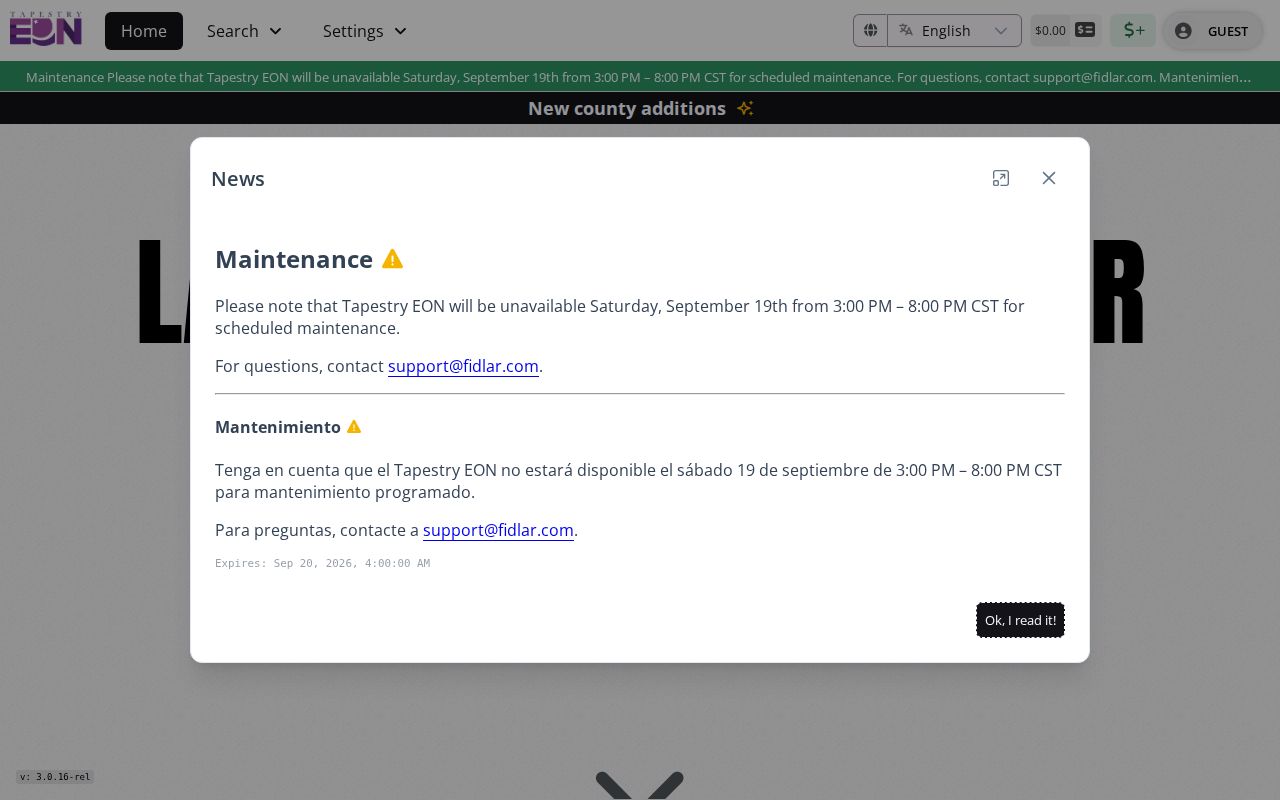
That entry page is a gateway, not a parcel record. Open the indexed deed image itself before assigning any grantor or grantee to an Owen County ownership timeline.
Bridge Owen County Previous Owners with Microfilm
The Indiana State Library preliminary microfilm inventory lists Owen County deed indexes covering 1819 through 1902. Nothing there conflicts with the Recorder's online depth. The two describe different formats. The Recorder reports modern index and image reach, while the library names an early microfilm run that rescues a search when the web interface, a spelling variant, or an image path fails. Use the film as an index-to-volume bridge. Search surname variants and initials. Save the deed book and page. Then read the deed itself. The library warns that its inventory is preliminary, so confirm availability before a visit or copy request. Land Entry Book 1, cataloged as ISLG 977.201 O97zo, is another early lead, though it never replaces a county deed.
Note: Microfilm can point to an early instrument, but only the deed supplies the parties, terms, and legal description to verify.
Reach Owen County Former-Owner Records Four Ways
A complete search keeps the fallback chain alive. No one should assume every historic Owen County deed is easy to pull online, because each route below serves a different need.
| Access route | Best use | Important limit |
|---|---|---|
| Tapestry EON / Laredo | Remote name and instrument search | Pay-per-search or subscription access |
| Recorder public terminal | In-person index and image work | Office is closed noon to 1 |
| Mail or county APRA request | A specific existing deed or index reference | Describe records with reasonable particularity |
| State Library holdings | Microfilm, land entry, historic maps, probate clues | Catalog leads are not certified deeds |
The Recorder sits in Room 201, 60 South Main Street, Spencer, and answers at 812-829-5013. Hours run 8 to 4 on weekdays. Lunch closes the office from noon to 1. County guidance sends any remote request involving more than three documents or names to the Public Records Request Form. Indiana APRA covers existing records described with reasonable particularity. It does not make the office build a custom ownership history for a requester.
Repair an Owen County Chain Broken by an Estate
A deceased former owner may never have signed an ordinary bargain deed between two living parties. Probate orders explain the jump. So can a personal representative's deed, a will, or later conveyances from heirs. Owen County probate and will holdings reach deep into the nineteenth century, with one cataloged series indexed to 1966. The Clerk holds probate court records now. Indiana MyCase is the online route when a case is public. Marriage and vital indexes help when a surname changed. They still do not transfer land. Use them to identify the right person, then return to the probate authority and the deed that moved the parcel. Owen Circuit Court 1 joined Odyssey in 2009, and Circuit Court 2 followed in 2015. Older case material may sit with the Clerk. A complete online docket is never guaranteed.
Place Owen County Past Owners on Historic Maps
Historic maps anchor an old Owen County owner in place. They also fix the time. The State Library's Owen County map catalog spans 1875, 1905, and 1911 county maps. It also holds Hixson plat books from the 1920 era. Sidwell volumes cover 1925 through 1941. Later atlases, directories, and Mapping Solutions books from 2018 and 2020 round out the shelf. Together they can tie an obsolete road label, a rural tract, or a vanished subdivision name to the exact years. That is when a former owner appears in Owen County property records.
One caution belongs here. A name printed on a plat is not proof of title on the map date. Treat it as a geographic clue. Then test it against the deed chain in the deed records. The State Library's property guide also flags companion sources. It lists Sanborn maps, newspapers, deeds, and plats. It notes one gap: no Owen County city directories sit in that collection. So skip any promised city-directory shortcut for Spencer or Gosport. Let the plats and deed records carry the work instead.
Keep Owen County Deeds Apart from Other Trails
Plenty of paper can touch one parcel without moving its title. A mortgage, release, lien, survey, plat, and deed may all describe the same land. Yet none of them names a new owner. Not until an instrument actually conveys or legally redirects the ownership interest. That is why the image and the legal description beat a loose name hit. They matter more than any index of property records.
Tax liens split by office in Owen County. State tax liens go to the Clerk. Federal tax liens are recorded with the Recorder instead. Judgments, bankruptcies, quiet-title suits, partitions, and probate matters exist too. Any of them can sit outside the normal deed sequence. Record them as context. Then wait for a deed or court order before crediting a change in the owner of record.
How Far Back Owen County Ownership Records Go
Owen County ownership paper reaches remarkably far back. The Recorder reports deed indexes and images to 1819. The State Library microfilm inventory covers deed indexes from 1819 through 1902, and Land Entry Book 1 offers another early lead. Stop at the last instrument you can verify rather than forcing the chain across a gap.
Know the honest stop point. A portal result or historic map is not a title opinion. Stop where the verified instruments stop, and use a title professional for a legal conclusion.
One boundary deserves mention. The Recorder does not run title searches. Staff are not bonded for that work. Tracing former owners still serves many fair purposes. House history, estate research, purchase diligence, and civic history all count. Just never use property records to harass or harm a person. For the mechanics and copy choices around a single instrument, see the Owen County deed records guide.